
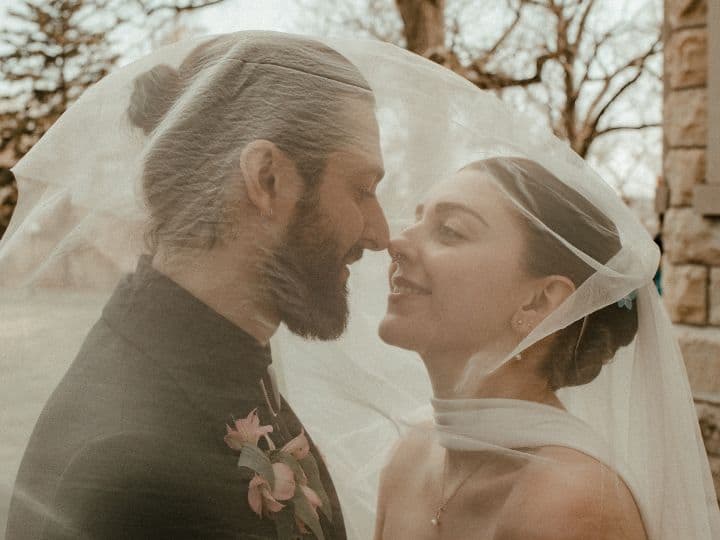
Planning a wedding for 100 people on a $15,000 budget might sound impossible when you're looking at today's wedding prices. Add a Victorian mansion, professional photography, catering, and all the other details that come with a wedding, and it can seem even more unrealistic.
But Sydney did exactly that.
For her wedding, Sydney and her husband originally hoped to spend around $5,000, eventually set a working budget of $10,000, and ultimately spent under $15,000 after receiving a gift from their families. They hosted about 100 guests at The Renwick Mansion in Davenport, Iowa, and found ways to spend money on the things that mattered most to them while cutting back in other areas.
Her wedding wasn't about finding a magical $15,000 wedding package. It was about making a series of intentional decisions that allowed her to get the experience she wanted without trying to recreate a wedding she couldn't afford.
If you're working with a smaller wedding budget, here are some of the biggest lessons from Sydney's planning experience.
1. Set Your Budget Before You Fall in Love With Your Wedding Ideas
Sydney's first piece of advice for couples is one of the most important: set your budget before you start committing to your vision.
She initially thought she and her husband could spend around $5,000. Once she started researching, she quickly realized that wasn't realistic for the type of wedding they wanted.
Instead of continuing to build a $20,000 wedding in her head and figuring out how to cut it down later, she found the Weddings Under 10K community on Reddit and started looking at what other couples were accomplishing with similar budgets. That helped her establish a more realistic $10,000 target.
This is an important distinction.
Your budget isn't just a number you use to track expenses after you've made your decisions. It should help determine which decisions you make in the first place.
Before you start saving hundreds of inspiration photos, sit down with your partner and ask:
What is the maximum amount we're comfortable spending?
Who is contributing financially?
What money do we want to protect for other goals?
Which wedding elements matter most to us?
Where are we willing to compromise?
Once you know those answers, you can start building a wedding that fits your actual life instead of trying to reverse-engineer an unrealistic Pinterest board.
2. Consider Getting Married in the Off-Season
One of Sydney's biggest savings came from something that didn't require any DIY work at all: choosing a less expensive time of year.
She and her husband originally wanted a fall wedding, but they discovered that both venues and vendors could be more expensive during the popular wedding season.
They ultimately chose an off-season wedding (November through April) in Iowa, which Sydney estimated saved them approximately $5,000 across the venue and vendors. That savings was more important to them than getting married in October.
This is a great example of a budget decision that doesn't necessarily make your wedding feel less special.
Instead of asking:
"How can we make an October wedding cheaper?"
You can also ask:
"Would we rather have an October wedding, or would we rather have $5,000 more available for the rest of our wedding?"
Neither answer is wrong.
The important thing is understanding the trade-off before you book.
If you're flexible on your wedding date, ask venues and vendors about:
Off-season pricing
Weekday pricing
Friday or Sunday weddings
Less popular months
Date-specific promotions
Minimums during different seasons
Even if you don't save exactly what Sydney did, changing your date can be one of the more powerful ways to change your overall wedding budget.
3. Look Beyond Your Own City
Sydney and her husband lived in Chicago, where the venues they were finding started around $7,000 for only about six hours of rental time.
That was too large a portion of their budget, so they started looking at nearby cities instead.
They eventually found Davenport, Iowa, approximately two hours away, and discovered that their money could go much further there.
This is something budget-conscious couples should seriously consider.
If you're searching only within the city where you live, you may be comparing yourself against a much more expensive local wedding market.
Try expanding your search radius and looking at:
Nearby towns
Smaller cities
Rural areas
Suburbs
Destinations within a few hours' drive
You don't necessarily have to plan a destination wedding to benefit from a different wedding market.
Just make sure you account for the potential trade-offs, such as travel, accommodations, transportation, and whether your guests can realistically get there.
4. Look for a Venue That Provides More Than Just a Pretty Space
The Renwick Mansion was a major part of Sydney's budget strategy.
The venue rental was approximately $3,500 with rentals, but what made it particularly valuable was what that rental included and how long they could use the property.
Sydney and her husband had the entire house for the weekend. They could arrive Thursday, set up before the wedding, stay overnight, hold the wedding Saturday, and clean up Sunday rather than having to rush everything into a single rental window.
For Sydney, the multi-day rental wasn't just convenient. It changed the economics of the wedding.
She didn't have to hire people to set everything up and tear everything down within a short window. Her family could handle much of the work themselves.
When you're comparing venues, don't just ask:
"How much is the venue?"
Ask:
"What does that price actually allow us to do?"
Look at:
Rental length
Setup time
Breakdown time
Tables and chairs
Getting-ready spaces
Overnight accommodations
Parking
Sound equipment
Lighting
Cleanup requirements
Outside vendor policies
Required staffing
Additional fees
A venue that costs slightly more upfront can sometimes be the better deal if it eliminates several other expenses.
5. Let the Venue Influence Your Wedding Design
Sydney initially envisioned bright spring colors.
But after seeing the mansion in person, she realized how much the existing architecture influenced the overall aesthetic. The ornate wallpaper, hardwood floors, marble mantels, and darker atmosphere naturally pushed her toward a moodier design.
Her biggest lesson?
See your venue before you make too many décor decisions.
Sydney had already purchased her flowers before seeing the space in person, which meant she had to work around a contrast between her bright spring flowers and the darker Victorian setting.
She ultimately loved how everything came together, but she wished she had seen the venue sooner.
This is especially important when you're getting married somewhere with a strong existing aesthetic.
A blank event hall may allow you to create almost any look. A historic mansion, garden, industrial space, or colorful restaurant already has a visual identity.
Instead of fighting that identity, use it.
If the space already has beautiful architecture, interesting wallpaper, historic details, gorgeous windows, dramatic lighting, unique furniture, or beautiful outdoor scenery, you may not need to spend as much money creating a backdrop from scratch.
In Sydney's case, guests were taking photos throughout the mansion, so she didn't need to create a separate photo wall or elaborate photo area.
6. Spend More on Your Priorities and Less Everywhere Else
Sydney didn't try to make every category of her wedding equally impressive.
Her biggest priorities were the venue, photography, and catering.
Those categories took up a significant portion of the budget, but she was comfortable spending there because they mattered to her.
Meanwhile, she saved through things like:
Family-provided videography
Family helping with photography during getting-ready portions
DIY and family-made flowers
A playlist instead of a DJ
A multi-day venue rental that allowed them to handle setup and cleanup themselves
This is one of the most important principles for planning a wedding on a smaller budget:
You don't necessarily need to spend less on everything. You need to decide what you want to prioritize splurging on.
If photography is extremely important to you, you may decide to spend more there and have simpler flowers.
If food is your priority, perhaps you choose a less expensive dress.
If you care most about your venue, you might accept a simpler entertainment option.
Your budget becomes much easier to manage when you stop asking, "How do I make everything cheap?" and start asking, "What do I actually care about?"
7. Use Your Community, but Be Willing to Let People Help Their Way
Sydney had family members and friends with valuable skills who helped throughout the wedding.
Her cousin provided videography. Family members helped capture getting-ready photos. Her mother-in-law made floral arrangements. A friend created the wedding arch.
But Sydney also made an important point about accepting help:
If you're asking someone to take something off your plate, you have to let them do it.
She explained that her friend made the arch differently from how Sydney had originally imagined it, but the finished result ended up being beautiful.
That's a lesson that goes beyond saving money.
If someone is genuinely volunteering their time to help you, you have to decide whether you care more about the exact execution or about having that task removed from your responsibilities.
If you can't let go of control, you may end up managing the person who is supposedly helping you, which defeats the purpose.
Before asking someone for help, ask yourself:
"Am I comfortable letting this person do this their way?"
If the answer is no, you may be better off hiring someone or handling the task yourself.
8. Use Local Recommendations When You're Hiring Vendors in an Unfamiliar Area
Sydney was planning her wedding from Chicago in a city where she had never been before.
Instead of blindly choosing vendors from Instagram, she asked people who actually lived in the area.
She used the Quad Cities subreddit to ask for recommendations within her budget. That's how she found both Bridges Catering and Amelia Charleen Photography.
This strategy can be especially useful if you're:
Getting married somewhere you don't live
Planning a destination wedding
Looking at a smaller wedding market
Having trouble finding vendors through traditional wedding websites
Ask local people:
Who did you use?
Who would you recommend?
Who should I avoid?
Who is reasonably priced?
Who is familiar with this venue?
Which vendors are popular locally?
You can still use platforms like The Knot and other wedding directories to research vendors, but don't underestimate the value of local, firsthand recommendations.
And once you've made a well-researched decision, Sydney recommends something else that can be surprisingly difficult:
Stop looking.
She intentionally avoided continuing to compare photographers after booking one she loved.
Constantly looking at other vendors can make you second-guess perfectly good decisions. Once you've done your research, made your choice, and feel confident about it, give yourself permission to move on.
9. Read Your Contracts With Your Actual Priorities in Mind
Sydney paid particular attention to what was included in her contracts.
For example, with catering, she specifically wanted table bussing because she didn't want herself or her guests responsible for clearing tables.
She also wanted important services and pricing clearly documented in writing.
This is a useful way to think about contracts.
Don't just ask:
"Is the price good?"
Ask:
"Does this contract actually cover the experience I think I'm buying?"
Before signing, look for exactly what is included, what costs extra, setup and breakdown responsibilities, cleanup responsibilities, staffing, rental items, overtime, cancellation terms, payment schedule, what happens if pricing changes, what happens if your date changes, backup plans, and any verbal promises you were given. And if something is important to you, get it in writing.
10. Don't Let Social Media Convince You That Your Wedding Needs to Look Like Everyone Else's
Perhaps one of Sydney's most important lessons wasn't about a specific vendor or budget trick.
It was about expectations.
She pointed out that social media can make it incredibly easy to compare your wedding to celebrations that may have much larger budgets, sponsored products, or completely different financial circumstances.
That's worth remembering every time you see a wedding idea and think:
"I need that."
You don't.
You can be inspired by someone else's wedding without treating it as your shopping list.
Instead, ask:
Do I actually want this?
Does it fit our budget?
Does it improve our guest experience?
Is it something we'll care about in five years?
Is there a simpler way to get the same feeling?
Your wedding doesn't become less beautiful because it doesn't look like a $50,000 wedding on Instagram.
One More Lesson: Don't Forget Who Has to Enjoy the Wedding
Sydney's story also includes a lesson she didn't fully realize until after the wedding.
She chose not to hire a day-of coordinator, thinking that because she had planned everything and created a timeline, she would be able to simply enjoy the day.
Instead, questions and problems still made their way back to her.
She found herself acting as the coordinator when she should have been able to simply be the bride.
This is an important budget consideration because saving money doesn't always mean eliminating a vendor completely.
Sometimes the better question is:
"What responsibility am I taking on by not hiring this person?"
If you skip a coordinator, who answers vendor questions?
If you use drop catering, who manages the food?
If you DIY your décor, who sets it up?
If you use a playlist instead of a DJ, who manages the music?
If your venue requires you to clean up, who does it?
A budget-friendly choice can still be the right choice. You just need to understand the work that comes with it.
Sydney's experience with the playlist was a perfect example. She saved money by skipping a DJ, but she ultimately wished she hadn't because managing the music was a lot more work than expected.
The cheapest option isn't always the lowest-stress option.
Final Thoughts: A $15K Wedding Doesn't Have to Feel Like a $15K Wedding
Sydney's wedding is a great reminder that planning a budget wedding isn't necessarily about cutting everything down to the cheapest possible version.
It's about making decisions intentionally.
She changed her wedding season.
She expanded her geographic search.
She found a venue that offered significant value beyond a single day.
She prioritized photography, catering, and the venue.
She accepted help from people she trusted.
She used local recommendations.
She carefully reviewed contracts.
She made some decisions herself and let other people handle others.
And perhaps most importantly, she learned that not every decision has to be perfect for the wedding to be meaningful.
If you're planning your own wedding on a limited budget, you don't have to recreate Sydney's wedding. You don't need a Victorian mansion, a specific season, or a particular set of vendors.
Instead, take the bigger lesson from her experience:
Figure out what matters most to you, set a realistic budget around it, and then build the wedding that fits your life.
That's how you can create a wedding that feels beautiful and intentional without spending money simply because the wedding industry tells you that you should.
Want More Real Wedding Inspiration?
🎧 Listen to the full episode: Planning a Wedding at a Victorian Mansion for 100 Guests Under $15K | Bride Highlight Ep. 026