
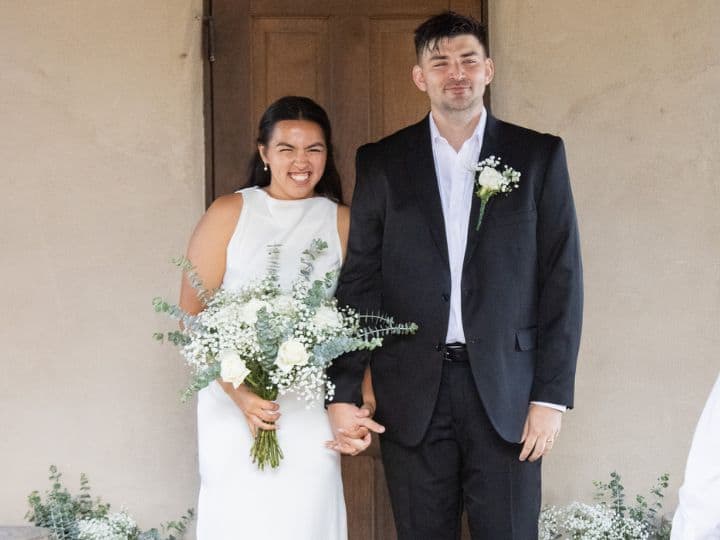
When you hear "micro wedding," you might picture a couple quietly exchanging vows with a handful of people and skipping things that make a wedding feel special.
But a micro wedding doesn't have to look or feel that way.
Megan's wedding is a great example. With only about two months to plan before she started medical school, she and her husband decided against a traditional wedding and reception. Instead, they had an intimate ceremony with their immediate family and then held a larger celebration with friends two days later.
The entire wedding and after-party celebration came in at under $5,000.
What makes Megan's experience particularly helpful isn't just the final number. It's the way she approached the entire wedding: decide what matters, rethink the traditional wedding structure, find creative ways to save, and don't be afraid to make the celebration your own.
Start by Deciding What Your Wedding Actually Needs to Be
One of the biggest lessons from Megan's wedding is that you don't have to start with the mindset that your wedding needs to look like every other wedding you've attended.
Originally, Megan wasn't even sure what kind of wedding she wanted. She considered eloping, having a destination-style experience, or having a micro wedding.
Her two-month planning timeline helped push her toward something smaller, but so did the reality of creating a guest list.
Megan and her husband initially wanted their families there. Once they started adding friends and other people they knew, the list quickly grew.
Eventually, they decided to keep the actual wedding to the people they most wanted there and celebrate with a larger group separately.
That is an important distinction.
You don't necessarily have to choose between an elopement and a 150-person wedding. There are plenty of options in between.
You could have:
A family-only ceremony
A small ceremony followed by dinner
A courthouse wedding followed by a party
A micro wedding with a larger casual celebration later
A destination ceremony with a hometown celebration afterward
A small wedding now and a larger anniversary celebration later
The goal isn't to find the "right" definition of a micro wedding. It's to decide what works for you.
As Megan put it, "your wedding is what you want it to be."
Consider Separating the Ceremony From the Celebration
This was one of the most creative parts of Megan's wedding.
She and her husband had their ceremony on a Thursday with 12 people, including the two of them. Afterward, they went to breakfast together.
Two days later, they held an after-party with 50 people.
This allowed them to have two very different experiences.
The wedding itself could remain intimate and focused on their families. The after-party could be more casual and centered around bringing their different groups of friends together.
And because the after-party wasn't trying to function as a traditional wedding reception, they didn't have to recreate a full reception timeline.
There wasn't pressure to have a formal ceremony, cocktail hour, dinner service, dancing, speeches, and every other traditional reception element.
Instead, they focused on food, activities, and spending time together.
This is worth considering if your dream is a small wedding, but you still want to celebrate with more people.
You can have the meaningful, intimate ceremony without paying to host every guest at the ceremony itself.
Build Your Guest List Around Your Priorities
Guest count is one of the biggest decisions you'll make because it affects so many other parts of your wedding.
More guests generally means more food, drinks, seating, space, invitations, rentals, and potentially larger venues.
Megan's approach was different for each part of the celebration.
For the ceremony, she and her husband kept it essentially to family and people married into the family.
For the after-party, they had to think more carefully about who to invite.
One question they used was essentially: Who are the people we are genuinely close to in this season of our lives?
That's a useful framework if your guest list keeps growing.
Instead of asking "Who have I ever been friends with?" try asking:
Who do we regularly keep in touch with?
Who would we call if we needed help?
Who are we genuinely excited to celebrate with?
Who is an important part of our lives right now?
Who do we want to spend this day with?
You may still have difficult decisions, but having a clear framework can make them easier.
Decide What Is Worth Spending Money On
Megan didn't approach her budget by cutting every possible expense.
Instead, she looked for opportunities to save so she could spend money on things she genuinely cared about.
For her, live music was one of those priorities.
She had played violin growing up and loved live music, so she chose to hire a violinist and guitarist for the ceremony.
Because the ceremony was short, the musicians were only needed for a limited amount of time.
This is a great example of a budget principle that can work at any price point:
You don't have to spend equally across every category.
If photography is extremely important to you, allocate more of your budget there.
If you couldn't care less about elaborate floral arrangements, simplify them.
If food is your favorite part of a wedding, prioritize the meal.
If you love music, put your money toward the experience of having live musicians.
The important part is knowing your priorities before you start spending.
Don't Assume DIY Means Doing Everything Yourself
Megan described herself as a DIY person, but she also knew her limits.
She was comfortable using Canva and creating relatively simple projects. She also experimented with ideas before committing to them.
That last part is important.
Don't wait until your wedding week to discover whether a DIY project is actually manageable.
Megan did trial runs of ideas. If something worked, she kept it. If it didn't, she was willing to spend money on another solution.
That gives you a much healthier approach to DIY:
Find an idea you like.
Determine whether you can realistically make it.
Do a test version.
Estimate the actual cost and time.
Decide whether the savings are worth the effort.
Outsource it if it isn't.
For her bouquet, Megan used real flowers including white roses, eucalyptus, and baby's breath. Her mother-in-law helped source the flowers, and Megan used chicken wire to create the bouquet structure.
The project also became a bonding experience with her future mother-in-law.
That's another benefit of DIY that doesn't show up in a budget spreadsheet: sometimes the process itself becomes part of the memories.
Look for Newer Vendors and Talented Friends
One of Megan's biggest savings came from photography.
Her friend, Sarah Phipps, was interested in getting into the wedding photography business and offered to photograph Megan's wedding for free in exchange for the opportunity to build experience.
Megan trusted her friend's ability and was thrilled with the result.
She also worked with a newer videographer who was still building their business.
This strategy can potentially create opportunities for couples with tight budgets, but it's important to understand the trade-off.
A newer wedding professional may have less wedding-specific experience than someone who has been working in the industry for years.
Before booking someone newer, ask yourself:
Am I comfortable with their current skill level?
Have I reviewed their existing work?
Do we have similar expectations?
Are they clear about what is included?
Do I understand what happens if something goes wrong?
Am I comfortable with the level of risk involved?
Megan's advice was simple: don't be afraid to reach out and ask.
You may know someone who is interested in turning a skill or hobby into a business. They may be looking for exactly the kind of experience your wedding can provide.
Just make sure the arrangement works for both sides.
Think Beyond Traditional Wedding Vendors
Megan's after-party didn't have a traditional vendor team.
Instead, food came from family and friends. A family friend who was interested in starting a charcuterie business created the charcuterie setup, with Megan covering the materials.
Her family prepared dishes that represented both sides of their family, including jambalaya and lumpia.
This made the meal more personal while also helping keep costs down.
Again, this isn't necessarily about telling every couple to have their family cater their wedding.
It's about asking:
What could we do differently from a traditional wedding?
Maybe that's:
A family-style meal
A favorite restaurant
A brunch reception
A dessert-focused celebration
A potluck-style gathering, if appropriate for your event
A friend making your cake
A casual food setup instead of formal plated service
The smaller your guest count, the more options you may have.
Your Venue Still Matters
One misconception about budget weddings is that you have to choose the least expensive-looking space.
Megan didn't approach it that way.
She specifically wanted a ceremony venue that felt beautiful and fit the aesthetic she wanted.
She found Chapel Dulcinea in the Texas Hill Country and felt that the space gave her the wedding-day aesthetic she wanted without requiring a large traditional venue.
Accessibility was also important because older family members were attending.
For the after-party, the priorities were different.
She wanted an Airbnb with enough space and activities to bring together different groups of friends. The property had outdoor areas, a game room, and recreational space that helped people interact.
This demonstrates an important venue-selection strategy:
Choose the features that actually matter for the event you're hosting.
For a traditional reception, that might be a dance floor and catering kitchen.
For a casual after-party, it might be outdoor space, games, seating areas, and enough room for people to spread out.
Remember That a Smaller Wedding Can Reduce More Than Your Budget
Megan repeatedly came back to one word when describing her wedding experience: Stress-free.
With fewer guests, she didn't feel the same pressure to constantly monitor whether everyone was having a good time.
Her family was also willing to help with small tasks throughout the day.
That meant she wasn't carrying every logistical responsibility herself.
A smaller wedding doesn't automatically mean no stress. But reducing the number of moving pieces can make it easier to focus on the actual experience.
And that was ultimately Megan's biggest priority.
She wanted to marry the person she loved, surrounded by people who loved them, without spending the entire day worrying about whether everything was going according to plan.
You Don't Have to Have a Wedding Party
Megan also chose not to have a traditional bridal party.
Part of the decision came from wanting to avoid unnecessary drama and financial pressure on her friends.
She was also aware that many of her friends were young and still establishing their careers. Asking them to take on travel, attire, and other wedding-related expenses didn't feel necessary to her.
But skipping a wedding party didn't mean skipping those friendships.
Her friends still celebrated with her at the bachelorette party and after-party.
This can be a helpful reminder if you're struggling with wedding-party decisions:
Someone doesn't have to have an official title to be important to your wedding.
You can involve people through readings, music, getting ready with you, special dances, photos, helping with DIY projects, or simply being present.
Look for Savings in the Structure of the Wedding, Not Just the Details
This might be the biggest lesson from Megan's $5,000 wedding.
Saving money isn't always about finding a $20 centerpiece instead of a $40 centerpiece.
Sometimes the bigger opportunity is changing the structure of the event itself.
Instead of 50 people at a ceremony and reception, Megan had 12 people at the ceremony and 50 at the after-party.
Instead of a full vendor team, she used a combination of friends, family, newer professionals, and DIY projects.
Instead of a traditional reception, she created a casual celebration with food and activities.
Instead of a large wedding dress budget, she chose a dress she loved that cost about $200 and could potentially be worn again.
These weren't random sacrifices.
They were intentional choices based on what mattered to her and her husband.
Your Wedding Doesn't Have to Look Like Everyone Else's
If you're planning a wedding on $5,000 or another tight budget, it's easy to look at social media and feel like you're constantly being told what your wedding "should" include.
Megan's story is a good reminder that there isn't one correct way to get married.
You can have the beautiful venue.
You can have meaningful music.
You can wear a wedding dress.
You can have gorgeous flowers.
You can celebrate with your friends.
You can have a memorable meal.
And you can still make choices that are completely different from a traditional wedding.
The key is deciding what matters to you and your partner before outside expectations start making those decisions for you.
As Megan said, "your wedding is what you want it to be."
That might mean a traditional wedding. It might mean an elopement. Or it might mean something in between.
The best budget wedding isn't the one where you cut the most.
It's the one where your money, time, and energy are going toward the things that actually matter to you.
Want More Real Wedding Inspiration?
🎧 Listen to the full episode: How Megan Planned an Austin, Texas Micro Wedding and After Party for Under $5,000 | Ep. 060
Listen to the full episode on Weddings 101