
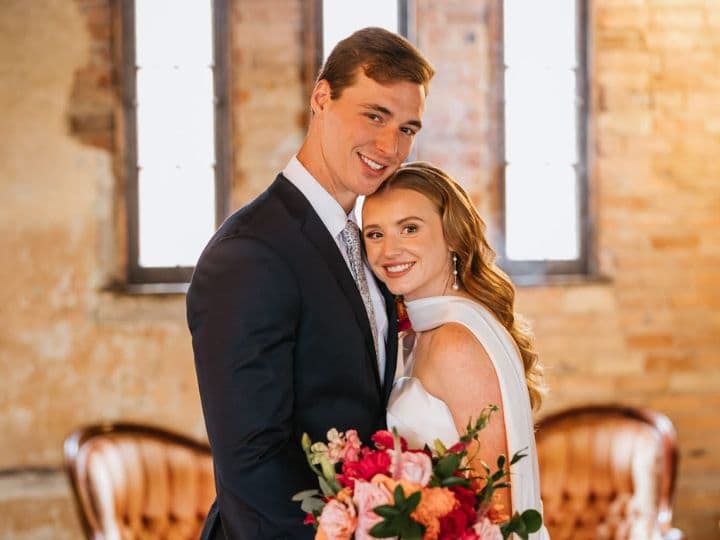
Planning a wedding is already a lot to manage. Now imagine trying to do it while living several states away from your wedding location.
That's exactly what Bailey Olmschenk did.
Bailey was living in North Carolina while planning her Minnesota wedding, where most of her family and friends still lived. Her wedding ultimately included about 175 guests, an outdoor ceremony, a separate reception venue, a wedding planner, and plenty of moving pieces to coordinate from a distance.
And, as Bailey openly shared, she is more of a "type B" person who likes to go with the flow.
That makes her wedding experience especially useful for anyone wondering how to plan a wedding from another state. Her biggest lessons weren't about having every detail perfectly organized. They were about knowing when to delegate, asking better questions, planning for problems, and accepting that some things will inevitably change.
Here are 10 lessons from Bailey's experience that can make planning a long-distance wedding much easier.
1. Start by Deciding Where You Actually Want To Get Married
Living somewhere different from your wedding location doesn't automatically mean you need to get married where you currently live.
For Bailey and her husband, Minnesota made sense because most of their friends and family were there. They were living in North Carolina at the time, but they wanted the people closest to them to be able to celebrate with them.
That decision then shaped everything else, including their wedding season and venue search.
They initially considered a summer wedding because they wanted good weather and outdoor photos, but many summer venues were already booked. So they ultimately chose September.
The lesson here is simple: choose your wedding location based on the people, priorities, and experience you want, not just where you currently live.
If you're planning from another state, establish this early. It will help you understand how much travel you'll need to do and what local help you'll need.
2. Find Someone Local Who Can Be Your Eyes and Ears
One of the biggest challenges of planning from another state is that you can't casually stop by a venue, attend a local vendor meeting, or look at something in person whenever you want.
Bailey experienced this firsthand.
She never personally toured her reception venue before booking it. Instead, her mom and some of her mom's friends toured it and FaceTimed her through the experience.
That isn't necessarily how every couple should choose a venue, but it shows that remote planning is possible when you have trusted people on the ground.
Think about who could help you locally:
A parent
A sibling
A close friend
Your wedding planner
Someone else you trust who knows the area
You don't have to send someone to every appointment. But having a reliable local person who can look at something in person can be incredibly helpful when you're hundreds of miles away.
3. Consider Hiring a Planner Before You Think You Absolutely Need One
Bailey didn't initially have a wedding planner.
She and her husband started planning themselves and had already selected many of their vendors before bringing a planner into the process.
Eventually, they realized they needed help. Their planner became involved about five months before the wedding and helped with planning, design, setup, and day-of coordination.
One of the biggest benefits was that she saw problems Bailey and her husband hadn't.
For example, they had originally considered holding the ceremony at Bailey's parents' house. Their planner helped them think through the logistics, including transportation, bathrooms, chairs, and getting people in and out.
Bailey said that decision potentially prevented a much bigger problem on the wedding day.
Her experience is a good reminder that a planner isn't only useful for creating a beautiful wedding. A good planner can help you identify logistical problems before they become wedding-day problems.
And if a full planner isn't in your budget, you don't necessarily have to choose between doing absolutely everything yourself and hiring someone for the entire planning process.
Depending on what's available in your area, you could look into partial planning or month-of/day-of coordination.
4. Get the All-in Price Before You Fall in Love With a Vendor
This was one of Bailey's biggest lessons.
Her caterer initially provided a per-person food price. That price seemed reasonable to them, but later they discovered additional costs for things such as plates, silverware, napkins, service, and gratuity.
For their approximately 175 guests, those additional charges added up to thousands of dollars.
Bailey's advice was straightforward: ask about the all-in cost.
This is especially important when you're planning remotely because you may not have the same opportunities to ask questions face-to-face or catch something that isn't immediately obvious.
Instead of asking "How much is catering per person?" ask questions like:
What is included in the per-person price?
Are plates included?
Is silverware included?
Are napkins included?
Are servers included?
Is setup included?
Is cleanup included?
Is gratuity included?
Are there service fees?
Are rentals required?
Are there minimums?
What could cause the final invoice to increase?
You don't need to feel annoying for asking these questions.
You're not being difficult. You're trying to understand what you're actually purchasing.
5. Read Every Vendor Contract, Even if You’re Overwhelmed
Bailey openly admitted that she and her husband didn't do a great job reviewing their vendor contracts.
Their approach was essentially to read, skim, sign, and move on.
Once their planner became involved, she went through the contracts with them and identified details they needed to address, including items they needed to provide themselves.
That is an important lesson for any couple, but especially for couples planning from another state.
When you're already juggling travel, vendors, appointments, and communication from a distance, it can be tempting to think, "We'll deal with that later."
Don't.
Before signing, make sure you understand:
What's included
What's not included
Payment deadlines
Cancellation policies
Overtime rates
Setup and breakdown responsibilities
Rental requirements
Service fees
Gratuity
Travel fees
Weather policies
Venue restrictions
Alcohol rules
Delivery requirements
If something isn't clear, ask.
And if you have a planner or coordinator, ask whether they can review contracts with you.
6. Have a Real Backup Plan for Outdoor Events
Bailey really wanted an outdoor ceremony.
Because of that, she was willing to accept some weather risk. Her outdoor ceremony venue wouldn't refund the payment if it rained, but the reception venue could potentially accommodate the ceremony if the weather became severe.
There was even an additional cost associated with moving the ceremony indoors on short notice.
Fortunately, the weather cooperated at the right moments. It was cold and rainy earlier in the day, but the weather cleared enough for their outdoor ceremony and photos before the rain returned.
The important part isn't that Bailey got lucky.
It's that she knew what the risk was and had a backup option.
If you're planning an outdoor wedding, ask your venue:
What happens if it rains?
Where would the ceremony move?
Is the backup space already set up?
How much would moving indoors cost?
When do we need to make the decision?
Who makes the weather call?
What happens if the weather changes after we've made the decision?
Are there temperature, wind, or other weather restrictions?
You don't need to eliminate every risk from your wedding.
You need to understand the risk well enough to decide whether you're comfortable with it.
7. Don’t Let “Planning From Afar” Turn Into “I Don’t Need To Research Vendors”
Bailey was very relaxed when selecting some of her vendors.
She found her photographer through a friend's recommendation and hired a DJ after finding someone online at a relatively inexpensive price.
A vendor recommendation can be a great starting point. However, it shouldn't necessarily be the end of your research.
Even if someone you trust recommends a vendor, take time to:
Review their work
Read recent reviews
Understand their contract
Confirm exactly what services you're receiving
Ask how they handle problems
Confirm arrival and departure times
Make sure expectations are documented
This is especially important when you can't easily meet the vendor in person.
8. Choose What Deserves Your Money, Then Let the Rest Be Easier
Bailey and her husband couldn't prioritize everything equally.
Instead, they decided what mattered most to them.
They wanted the wedding to have a beautiful overall feel and a good experience for their guests. They prioritized the venue and decor while being more willing to compromise on location.
Rather than choosing a more expensive location closer to where Bailey had lived, they held the wedding in southern Minnesota, where much of her family and many friends were located.
That allowed them to put more emphasis on the atmosphere they wanted.
This is one of the most useful budgeting exercises you can do:
What do we want our guests to experience?
Then ask:
What things will actually create that experience?
Maybe your answer is:
Great food
A beautiful venue
A packed dance floor
Amazing photography
Being able to spend time with family
A meaningful ceremony
A relaxed atmosphere
Once you know your priorities, you can spend more confidently in those areas and be more willing to compromise elsewhere.
9. Give Yourself Permission To Change Your Plans on the Wedding Day
One of Bailey's most interesting wedding-day lessons involved photography.
Before the wedding, she thought golden-hour photos were something they absolutely needed.
But when golden hour actually arrived, she changed her mind.
She realized she'd rather spend that time with her family.
That's an important distinction.
Planning is about deciding what you think you'll want.
The wedding day is when you actually discover what matters to you in that moment.
Your priorities can change.
Maybe you planned 45 minutes for photos but decide you'd rather get back to your guests.
Maybe you thought you'd want a particular wedding tradition but realize it doesn't feel like you.
Maybe the timeline gets delayed because of weather.
That's okay.
A wedding timeline is a tool, not a contract with the universe.
10. Plan for Things To Go Wrong, but Don’t Make “Perfect” the Goal
This might be the biggest lesson from Bailey's wedding.
Things went wrong.
Their photos were delayed because of rain. Their transportation got lost and cost them about 30 minutes. Their officiant forgot part of the ceremony. Someone was accidentally burned while steaming Bailey's dress. Their marriage license wasn't signed immediately after the ceremony as planned.
And yet Bailey remembers it as a great day.
One reason is that she had a relatively go-with-the-flow personality. But another reason is that she and her husband had already decided that they wanted to be present with each other.
They weren't on their phones.
They reminded themselves that they didn't need to talk to every single guest.
And when something unexpected happened, they dealt with it and kept moving.
Bailey ultimately said that what mattered was having the right people there and being able to feel the love surrounding them.
That's a powerful reminder for any couple, but especially one planning from far away.
You cannot control every vendor.
You cannot control the weather.
You cannot control whether transportation gets delayed.
You cannot control whether someone forgets a line during the ceremony.
You can control how much energy you give those things.
A Simple Framework for Planning a Wedding From Another State
If you're currently planning your wedding from a different state, Bailey's experience can be boiled down into five priorities:
1. Establish Your Local Support System
Who can physically be there when you can't?
2. Get Extremely Clear on Costs
Don't budget based only on headline prices. Find out what is actually included.
3. Document Everything
Contracts, timelines, vendor responsibilities, venue rules, weather plans, and deadlines should all be easy to find.
4. Delegate Before You’re Overwhelmed
You don't have to wait until you're drowning to bring in help.
5. Build Flexibility Into the Plan
Your goal isn't to make it impossible for anything to go wrong.
Your goal is to make sure one unexpected problem doesn't take down the entire day.
Planning From Another State Doesn’t Have To Mean Planning Alone
The biggest takeaway from Bailey's wedding isn't that you need to become an expert wedding planner.
It's almost the opposite.
Bailey wasn't naturally obsessed with spreadsheets, timelines, or making every decision herself. She leaned on family, trusted people locally, and eventually a planner. She made decisions based on what felt important to her and accepted that not everything would go perfectly.
If you're planning a wedding from another state, focus less on trying to control every detail and more on creating a system that lets you make good decisions from a distance.
Find people you trust. Ask questions. Read your contracts. Know your true costs. Have backup plans. And when the wedding day finally arrives, remember that the goal isn't to prove how perfectly you planned it.
The goal is to actually experience the day you've been planning.
Want More Real Wedding Inspiration?
🎧 Listen to the full episode: Planning a Wedding From Another State: A Real Bride's Minnesota Wedding Story | Ep. 064