

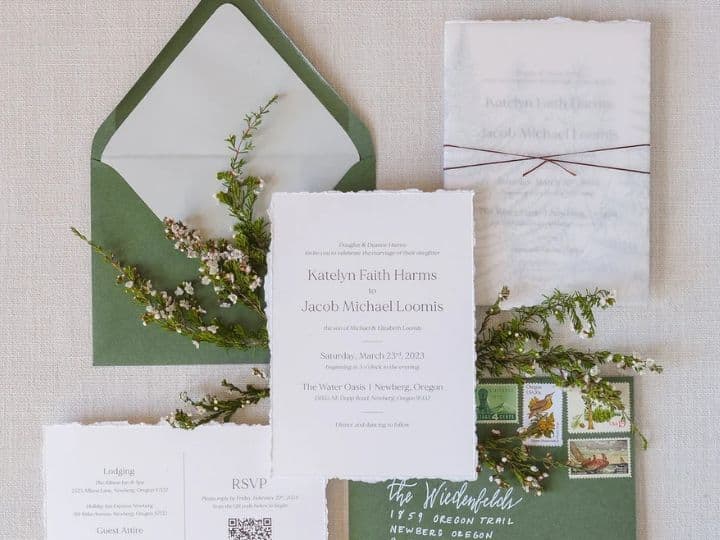
Wedding stationery can be one of those parts of wedding planning that seems simple at first.
You need invitations. Maybe save-the-dates. Then menus, signage, place cards, and a few other things on the wedding day.
But once you start researching, you quickly discover there are a lot more decisions involved. When should you send everything? How many invitations do you actually need? What belongs on the invitation versus your wedding website? And if you're trying to stay within a budget, is custom stationery worth it?
I recently talked with Rachel Wiedenfeld, owner and creative director of Rachel Wiedenfeld Studio, about exactly these questions. With experience in both graphic design and the wedding industry, Rachel shared practical advice about everything from stationery timelines and RSVP deadlines to DIY invitations, postage, and creating a cohesive look throughout your wedding.
Here are the biggest things to know before you start designing.
Start With Your Wedding Date, Then Work Backward
One of Rachel's biggest pieces of advice is to avoid thinking about stationery only in terms of your wedding date.
Instead, work backward.
For wedding invitations, Rachel recommends starting the process around seven months before the wedding. If you want a more cohesive stationery experience that includes save-the-dates, invitations, and day-of stationery, she recommends starting even earlier, around 10 months out.
That doesn't mean your invitations need to be mailed seven months before your wedding. It means that's a good point to begin the design and planning process.
The actual mailing date comes later.
Rachel's approach is to start with the date by which you need your final guest count. From there, determine how much time guests need to RSVP, how long the invitation needs to reach them, and how much time you need for printing, assembly, and addressing.
That backward planning can help prevent the classic wedding-planning problem of realizing that a deadline you thought was far away is suddenly right around the corner.
Do You Actually Need Save-the-Dates?
Save-the-dates can be helpful, but they're not mandatory.
If you're planning a destination wedding, have guests traveling significant distances, or are sending save-the-dates well ahead of your wedding, they can give guests useful advance notice.
But if you're working with a shorter engagement, Rachel recommends considering skipping them altogether.
If your wedding is six months away or less, sending a save-the-date and then quickly following it with an invitation may not accomplish much.
In that situation, putting your time and budget toward getting the invitation out may make more sense.
For a save-the-date, you generally don't need every wedding detail. Rachel recommends including your names, wedding date, and the city where the wedding will take place. Additional information can be included if you already have it, but you don't need to have every detail finalized.
Think of the save-the-date as a heads-up rather than the full information packet.
When Should You Send Wedding Invitations?
There isn't one universal date that works for every wedding.
Rachel prefers giving guests more time than the shortest timelines you may find online because the RSVP deadline needs to work backward from your actual planning needs.
Her preference is to have the RSVP deadline roughly one month before the wedding, giving the couple time to finalize things like guest counts, meals, and table assignments.
She also notes that there can be a few weeks between guests receiving an invitation and their RSVP deadline.
This is particularly important because your RSVP deadline isn't just about when you would like to know who's coming.
Your caterer, florist, rental company, venue, and other vendors may need information that depends on your final guest count.
So before choosing your RSVP deadline, ask:
When does my caterer need the final guest count?
When do I need to finalize seating?
When do I need meal selections?
How much time will I need to follow up with guests who haven't responded?
How much buffer do I want before the wedding?
Your invitation timeline should serve your planning timeline.
What Goes on a Save-the-Date vs. Wedding Invitation?
One of the easiest ways to make stationery more complicated than necessary is trying to put every piece of information everywhere.
Instead, think of each piece as having a specific job.
Save-the-Date
A save-the-date can be relatively simple.
At minimum, Rachel recommends including:
Your names
Your wedding date
The city where you're getting married
You can add more information if you already know it, but you don't need to include the exact ceremony schedule or every venue detail.
Wedding Invitation
The invitation needs to provide the information guests need to actually attend your wedding.
Rachel recommends including:
Your wedding date
The ceremony or event time
Venue information
Relevant additional details
A details card can provide information such as:
Venue addresses
Dress code
Lodging information
Recommended places to stay
Other important guest information
And then there's your wedding website.
Your website can hold the information that simply doesn't fit comfortably on a printed invitation suite.
That can be especially helpful if you have extensive travel information, multiple wedding events, transportation details, FAQs, or other information guests need.
Your Invitation Sets Expectations for Your Wedding
This was one of my favorite ideas from Rachel's interview.
Your invitation isn't just a pretty piece of paper. It's also communicating what guests should expect.
If you send a highly formal, heavily embellished invitation, guests may reasonably assume they're attending a more formal event.
If your wedding is a backyard celebration, casual dinner, or relaxed gathering, your stationery can communicate that instead.
The goal is that your stationery accurately represents your wedding.
Rachel described this as part of your responsibility as a host: your invitation helps guests understand how to prepare for the event.
That includes the overall design, wording, and level of formality.
So before choosing a stationery style, ask:
Does this actually look and feel like the wedding we're planning?
How Many Wedding Invitations Should You Order?
This is an easy place to accidentally overspend.
You generally don't need one invitation per guest.
Think in terms of households.
A couple typically receives one invitation. A family can generally receive one invitation addressed to the household.
Rachel recommends calculating your household count and then ordering approximately 10–15% extra.
Why?
Because things happen.
You may:
Make a spelling mistake
Address an envelope incorrectly
Have an invitation returned in the mail
Need to invite someone at the last minute
Want a few extras for your parents
Want to save one as a keepsake
Give one to your photographer for detail photos
Those extras can also give you some breathing room if something goes wrong during the mailing process.
And if you're investing in beautiful stationery, having a keepsake copy is especially worthwhile.
You Don't Need to Personalize Every Invitation
If you're ordering invitations for a large guest list, you may be wondering whether each printed invitation needs to have the recipient's name on it.
Not necessarily.
Rachel recommends keeping the main invitation relatively standard and handling recipient-specific information elsewhere, such as on the envelope or RSVP card.
One option she discussed is leaving a space for the number of seats reserved for the household.
That lets you maintain a consistent printed invitation while still communicating exactly who is invited.
It's a small decision that can save a surprising amount of time and complexity.
How Much Does Custom Wedding Stationery Cost?
Custom stationery can vary dramatically depending on the designer, guest count, materials, printing methods, and level of detail.
Rachel shared that she doesn't have a minimum budget or quantity for her packages and that every wedding is different.
For her work, two major cost drivers are household count and embellishments.
And embellishments aren't just expensive because of the materials.
They're often expensive because of the labor involved.
Think about things like:
Handmade paper
Deckled or torn edges
Wax seals
Ribbon
Custom finishes
Specialty printing
Hand assembly
If someone is physically tying ribbons or creating individual wax seals, you're paying for the time required to do that for every invitation.
That doesn't mean those details aren't worth it.
It simply means you should understand what you're paying for.
If your budget is limited, you can choose where you want the investment to go rather than assuming every invitation needs every possible embellishment.
DIY Wedding Invitations Can Be a Great Option
Rachel is very clear that there is nothing inherently wrong with DIY stationery.
She even DIYed her own wedding invitations.
The more important question is whether the DIY route fits your priorities.
One of the best ways to think about it is:
Are you saving money, or are you spending your time?
Sometimes you're doing both.
A template might look inexpensive when you first find it online. But then you may need:
Specialty paper
A printer
Ink
A paper cutter
A Cricut
Scissors
Ribbon
Tools for specialty finishes
Envelopes
Additional printing
Time to assemble everything
There's also the research.
Where will you print? What paper will you use? Will the colors look the same in person? How will you create the edges? How will you assemble everything?
If you're crafty and genuinely enjoy the process, DIY could be a great fit.
If the thought of assembling 100 invitations at midnight makes you want to cry, it may not be the right place to save money.
How to Make DIY Invitations Feel More Elevated
You don't need an elaborate custom suite to make DIY stationery feel thoughtful.
Rachel specifically highlighted paper selection as one area that can make a noticeable difference.
A beautiful design printed on ordinary office-style cardstock can feel very different from that same design printed on a paper with texture and substance.
If you're DIYing, consider investing your limited budget in one or two details rather than trying to recreate every luxury stationery trend.
For example, you might prioritize:
Better-quality paper
A thoughtful envelope color
A beautiful typeface
A simple illustration
A cohesive color palette
A well-designed details card
Then use your wedding website for information that doesn't need to be printed.
You don't need five different pieces of paper to create an elevated experience.
Personalization Doesn't Have to Mean "More"
One misconception about custom stationery is that personalization requires lots of elaborate details.
It doesn't.
Rachel talked about personalization through:
Colors
Typefaces
Artwork
Monograms
Venue illustrations
Pet illustrations
Meaningful symbols
Small hidden details
That last category can be particularly fun.
Maybe there's a flower that means something to you. Maybe you incorporate a location that's important to your relationship. Maybe there's a tiny illustration that only your closest friends recognize.
Personalization can be obvious or subtle.
The goal isn't to prove how many custom details you can fit into an invitation.
It's to make the stationery feel like you.
Choose a Stationer for Their Style, Not Just Their Price
If you're considering hiring a custom stationery artist, Rachel recommends looking at their existing work and thinking about whether you genuinely like what they create.
That doesn't mean you need to find someone who has already designed your exact dream invitation.
Instead, look for a designer whose overall style resonates with you.
Rachel also recommends giving a stationer examples of what you're drawn to about their own work rather than asking them to recreate another designer's work.
This is important for any creative wedding vendor.
You're not simply buying a finished product.
You're hiring someone's creative expertise, style, experience, and process.
The better the match between your vision and your vendor's existing style, the easier that relationship is likely to be.
Think Beyond the Invitation
Your stationery doesn't necessarily stop when the invitations go in the mail.
If you want a cohesive wedding design, that visual language can continue throughout the wedding day.
Rachel works on pieces such as:
Menus
Signage
Escort cards
Bar menus
Cocktail napkins
Drink stirrers
Favors
Dance floor graphics
Welcome signs
These don't all have to match perfectly.
Instead, they can share elements from the invitation, such as typography, colors, patterns, illustrations, or other design details.
That creates a visual system rather than a collection of unrelated signs and paper goods.
Don't Forget About Postage
Postage is one of the easiest wedding stationery expenses to overlook.
Your invitation isn't necessarily going to cost the same to mail as an ordinary letter.
Weight, thickness, shape, and embellishments can all affect mailing requirements. USPS currently notes that decorated envelopes with features such as wax seals, ribbons, or strings can require nonmachinable postage. USPS also recommends taking embellished invitations to the Post Office and requesting hand-canceling when appropriate.
Rachel's advice is simple: take one completed invitation to your local Post Office before buying all your postage.
Have that actual finished invitation weighed and evaluated.
That way, you're not guessing.
And remember: if you make changes to your invitation after that point, such as adding another card or embellishment, the mailing cost can change too.
A Simple Wedding Stationery Planning Checklist
If you're feeling overwhelmed, start here.
About 10 Months Before the Wedding
If you want a cohesive stationery experience:
Research stationers
Determine your stationery budget
Start your design direction
Plan save-the-dates
Think about how your wedding design will translate into stationery
About 7 Months Before the Wedding
For invitations:
Hire or begin working with your stationer
Finalize your invitation design direction
Determine your household count
Gather invitation information
Start finalizing details cards and website information
Before Ordering
Double-check:
Names
Wedding date
Times
Venue names
Addresses
Website URL
Dress code
Lodging information
RSVP instructions
Spelling
And order approximately 10–15% extra if your budget allows.
Before Mailing
Take one completed invitation to the Post Office.
Confirm:
Weight
Postage required
Whether it is nonmachinable
Whether hand-canceling is appropriate
Any other mailing requirements
Then buy the appropriate postage and mail the invitations.
The Best Stationery Choice Is the One That Fits Your Wedding
There isn't one correct way to do wedding stationery.
You can spend thousands on a custom suite.
You can DIY your invitations.
You can use a template.
You can combine printed invitations with a digital RSVP.
You can keep everything incredibly simple.
The best choice depends on your budget, your priorities, your timeline, and how much time you actually want to spend on the process.
What matters most is that your stationery gives guests the information they need, accurately represents your wedding, and doesn't create unnecessary stress for you.
And if you do decide to invest in custom stationery, remember that you're not only paying for paper.
You're paying for the designer's experience, resources, creative direction, knowledge of printing and production, and the time required to turn your vision into something tangible.
Your wedding stationery can be beautiful without being excessive.
It can be personal without being complicated.
And most importantly, it should help your guests understand and experience your wedding before they ever walk through the door.
Want More Real Wedding Inspiration?
🎧 Listen to the full episode: Save the Dates, Invitations, and Day Of Stationery: Expert Tips from Rachel Wiedenfeld | Wedding Stationary Artist Highlight Ep. 024
Listen to the full episode on Weddings 101